As an ex-oceanographer and now science writer, a concert tour was just never something I thought I’d be a part of. And yet, in November it really felt like I was. Our partner in Music for the Ocean, violinist/composer Chad Cannon, grew up in Salt Lake City, and so he wanted to bring his fabulous show to his hometown so his family and friends could immerse themselves in the beauty of the oceans and his work. The Waterford School, located on an incredible K-12 campus at the foothills of Cottonwood Canyon, was an outstanding host for what basically turned into our three day residency.
The Gravitas of the Grey Whale
I want to give a major shout out to Bekka Joslin, the curator of the incredible Nature Lab at Waterford, as well as science faculty at the school. She’s created such a fantastic atmosphere of discovery of the natural world for the students. The Nature Lab is home to hundreds of species of vertebrates, both skeletons and taxidermy; it’s chock full of microscopes and brine shrimp and tanks of fish. It’s the kind of hands-on immersion that can’t help but create awe in the great diversity of life of our planet. Among the many specimens Bekka curates is a nearly complete gray whale skeleton.
It was Bekka’s inspiration to move the skull onto the stage for the concert. The effect was intense. Visually, the massive skull balanced the grand piano on the other side of the stage, placing science and music in equilibrium. Genius lighting designer Evan Murnane figured out how to light the skull from the inside as well as surround it in color. It certainly felt like the skull was there as emissary or a witness from the deep to the art, but also, at times, with the lights dancing across its powerful structures almost felt like nature and science were in an ephemeral, unusual, and precious conversation.

The Inspiration of the Sea Fairy
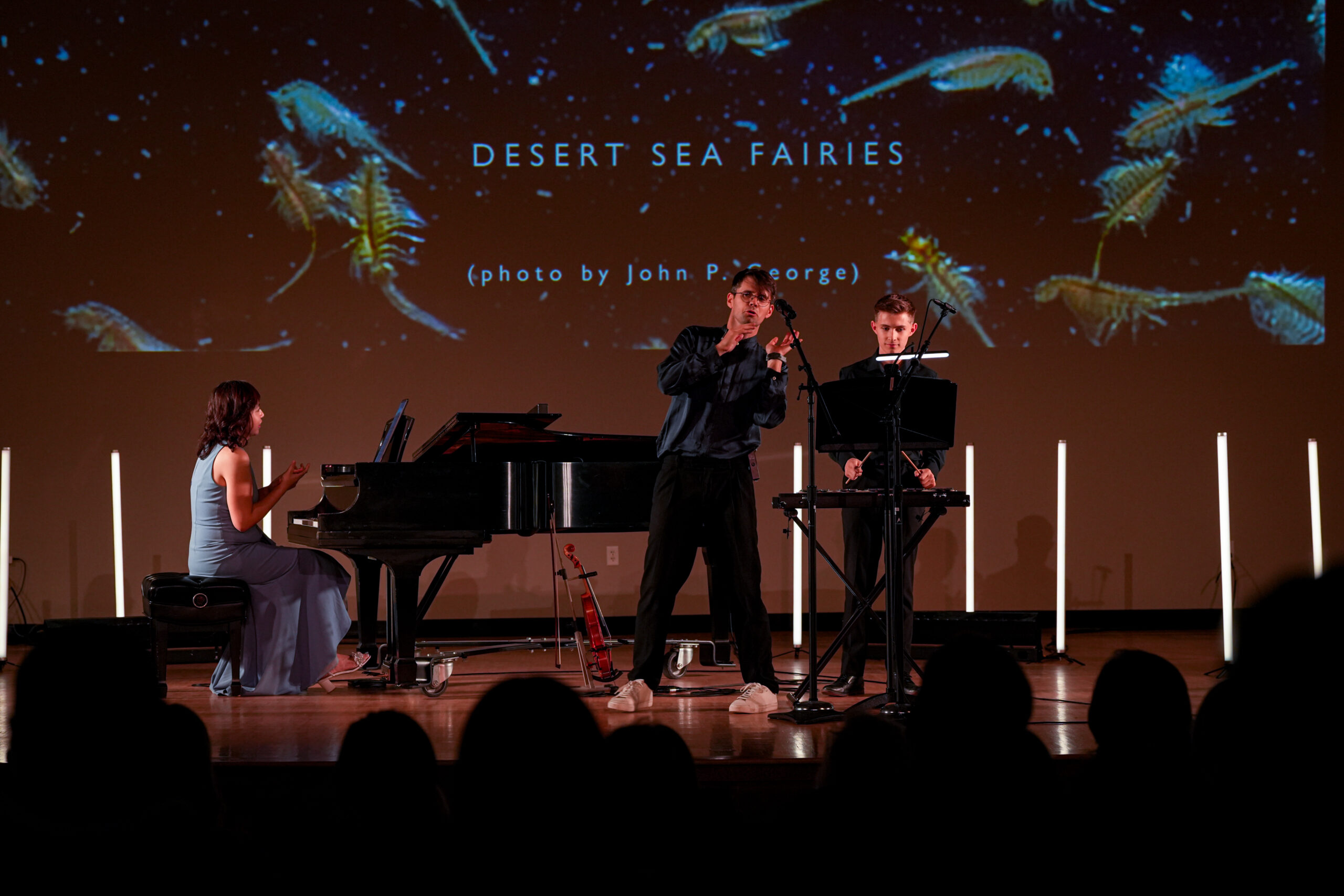
Chad had arrived in Salt Lake City a couple days before our shows were scheduled, and Bekka arranged for him to accompany a class on a field trip to the Great Salt Lake, along with Kyle Stone of the Great Salt Lake Ecosystem Program. Despite having grown up in the city, Chad said he hadn’t spent much time at the lake. Chad waded into the briny waters with a glass jar so that he could collect and observe the jerky dance of the lake’s iconic brine shrimp. These sea fairies drive a multi-million dollar industry. About ten years ago, if you ate a farm-raised shrimp anywhere in the world, there’s a 50% chance that it had been fed brine shrimp from the Great Salt Lake. The number’s fallen a bit with competition, but it’s a tangible reminder of just how connected we are, globally, and how invisible our underwater resources are to us too often.
As Chad is wont to do, he immediately wrote a piece inspired by the brine shrimp. His ability to do this is mind-blowing. Chad sent the music to the brilliant animator Tim Rauch, who started to create the visuals to go along with the piece.
The next day, I arrived in Salt Lake City and had the pleasure of speaking about jellyfish and coral with Waterford’s AP Environmental Sciences class taught by Justin Joslin. I might have talked a bit too much, but the students had great questions and it was a ball. Afterwards, I hung out in the Nature Lab’s excellent biodiversity while the musicians and light and sound designers ran through rehearsals.
For the Upper School
First thing in the morning, we performed a shortened show for the upper school and you could tell that the students, who straggled in weary from studying for the upcoming week’s finals, were captivated. They didn’t expect to have so much fun at a classical music concert. Our public show was scheduled for that night, and immediately following the morning show, ticket sales jumped as the word spread about how cool the concert is.
And when I say “we performed” what I mean is that Chad and Hui performed, and Evan and Will did all the work to make it sound fabulous and look amazing. I had the honor of introducing the show and providing a bit of context.
We were invited to have lunch with the students at Waterford, and wow, what an incredible cafeteria. The food was fresh and healthy and delicious. A student, Kehoe Brogna, sat down to eat with us. He’s one of those kids who has so much maturity you don’t want to remember what you were like at his age. He is a percussionist and composer and by the end of the meal, Chad had invited him to accompany Hui on the brine shrimp piece on the glockenspeil that very evening. A few hours later I saw Chad writing out the music and sending it to Kehoe. It was around 3 pm and we would perform at 7 pm. (And by “we” I mean they.) I was, yet again, amazed.
The Big Night
Before the show, with Bekka’s encouragement, we set up tables in the theater lobby to share some of our stories of Tela. Bekka had a sampling from the Nature lab including brine shrimp and marine fossils. Lynn de Freitas, the Executive Director for Friends of the Great Salt Lake joined us as well, bringing her beautiful energy around stewardship with her.
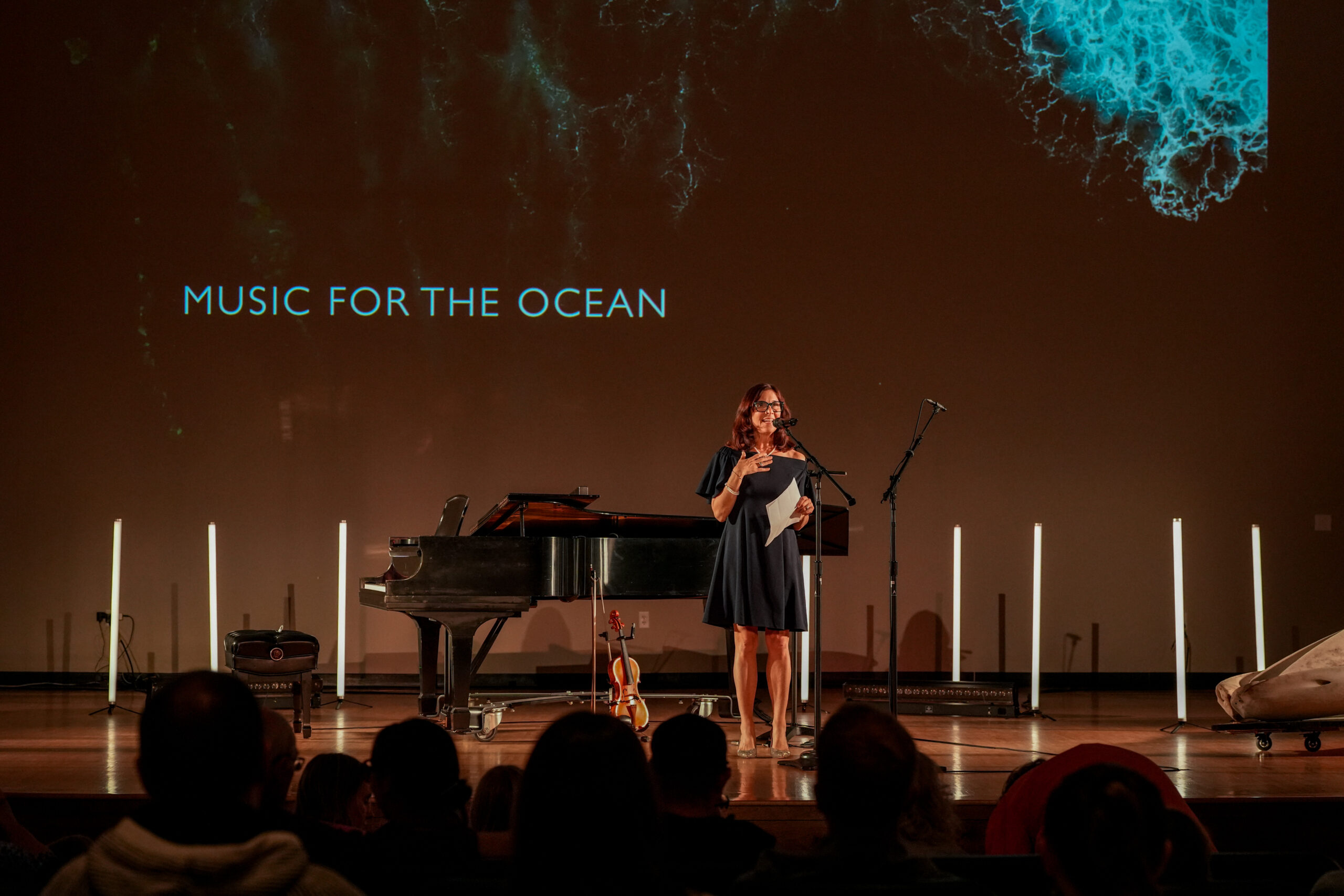 The performance that night was elevated. The students returning with their families gave the pre-show vibe an extra spark. Hui’s rendition of the Pufferfish piece, one inspired by the story of a male pufferfish working to build an artistic sculpture to lure a mate, was even more tender and soulful than usual.
Chad’s two young nephews joins him on stage dressed in grim reaper robes and carrying lanterns during the Deep Sea Fangs, a piece that takes its inspiration from the fantastical fish of the deep and their bioluminescent lures. And the string ensemble that Chad had played with when he was young, joined him on stage for the edgy piece called Electroreception.
A highlight was when superstar and local violinist Will Hagen, who plays a real Stradivarius, joined Chad for a duet during the piece about Dorado, one of the most muscular fish in the sea. The grey whale’s skull seemed to flash in appreciation of their virtuosity. (See the video below.)
The show ended with Sea Fairies, the piece Chad had been working on since his visit to the Great Salt Lake. Amazingly Tim had managed to create really cool animation in just two days. In addition to being visually stunning, it showed the life cycle of the brine shrimp and flashed to real videos of their fairy-like forms. I don’t know how Hui and Kehoe learned the piece so fast, but they were both incredible.
The show had gone on a bit too long, and it was a school night just before finals, so the panel discussion between Lynn, Kyle, and myself was a bit abbreviated. But the applause was roaring and the energy in the theater dynamic. Chad had a long, long line of family and friends who wanted to wish him congratulations.
For the Lower School
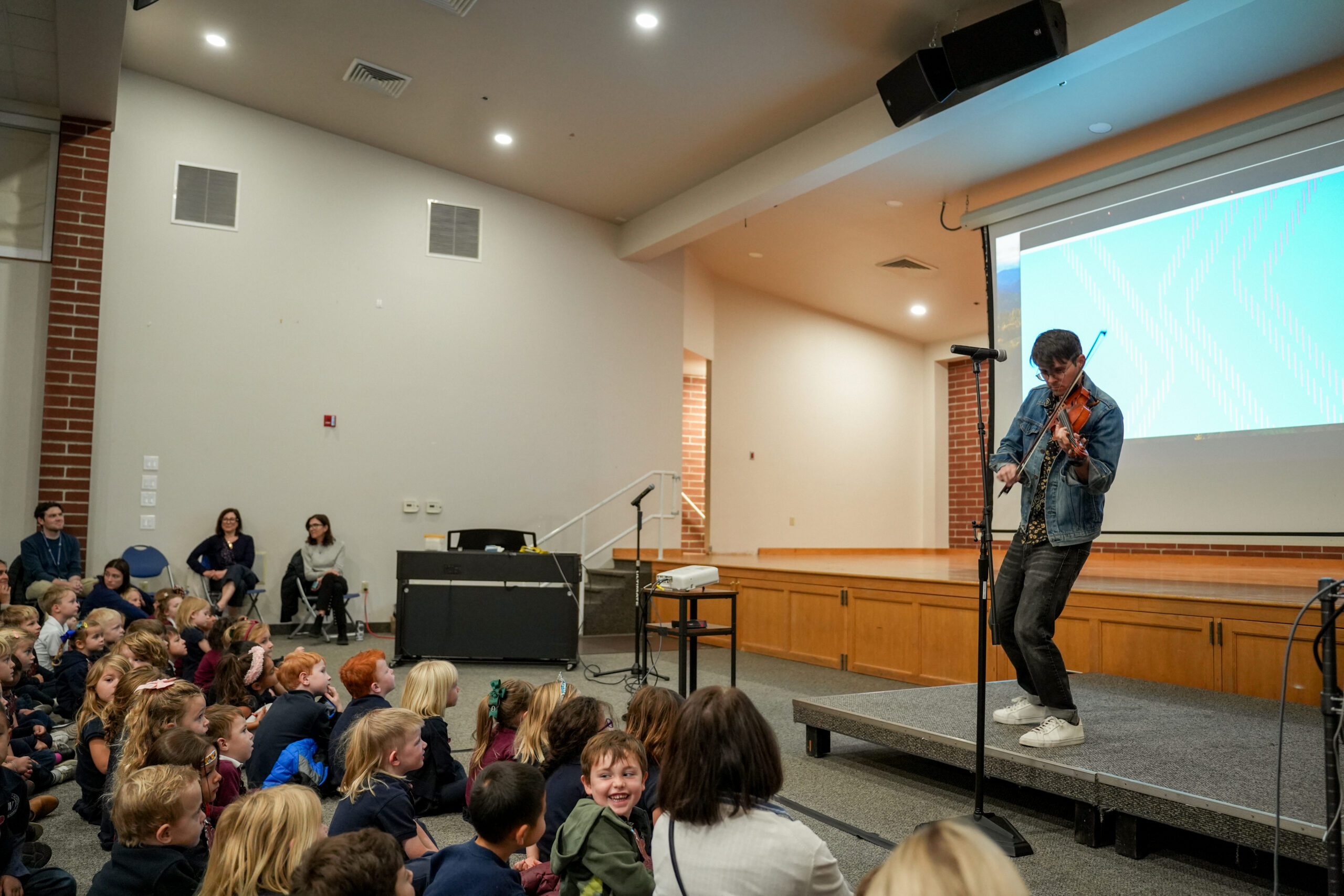
The next morning, still filled with adrenaline, Chad and I gave what’s become a spin-off of the concert: a science/song performance for the lower grades at Waterford. This includes me giving a bit of a talk on corals and jellyfish and Chad playing a half hour of the fan favs. About 500 kids were all sitting on the floor rapt by Chad’s playing. We had a few minutes for a Q&A and the older kids in the back of the room had terrific questions about coral bleaching and some solutions. One really young guy in the front had a question he just couldn’t hold back. His hand was raised in the “Oh! Oh! Mr. Kotter!” way, for anyone old enough to remember. It was actually a comment: His last name was Cannon too. Which, I think, shows just how cool Chad makes playing violin.
Onward to Spring City
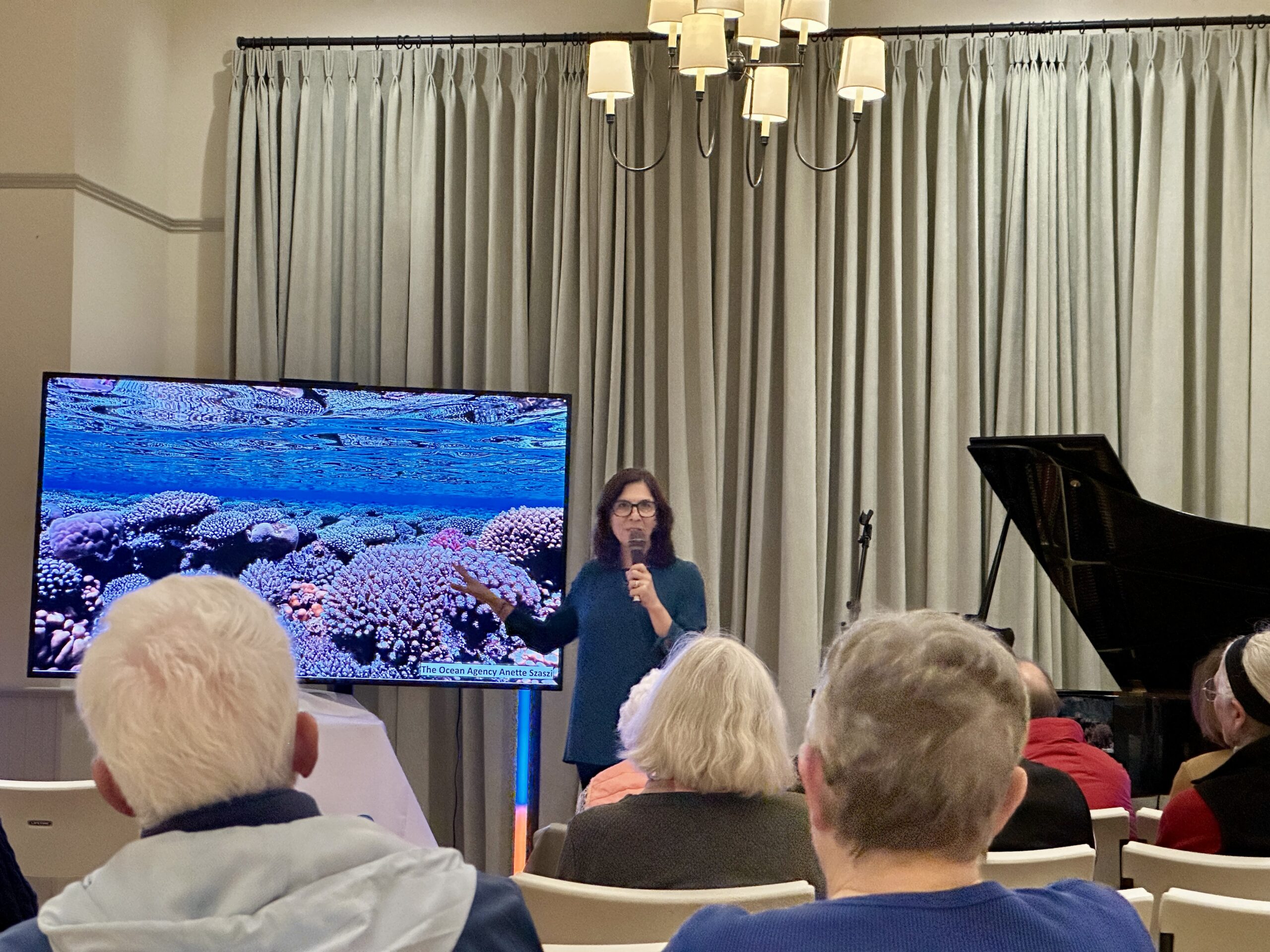
Then it was onward to Spring City, Utah, about 2 hours south of Salt Lake City. The small town has a beautifully restored community center with an elegant event space and a grand piano. Chad and I did an extended version of our science/song spin-off and there was a special treat for me.
Evan had left some of the lights he uses with Chad to drive back to LA. They are vertical pillars and run off an ap, and I got to play with them while Chad was playing. That meant I got to choose the colors of the lights to go along with Tim’s animations. The more I used the ap, the more I figured out. I could split the pillars into two or three colors, and even animate them. I was completely engrossed with how fun it was and took no photos of the show. Thank goodness for one kind member of the audience who shared a couple. It was an absolute delight to perform in such a warm, intimate venue.
Our trip to Utah was an unparalleled joy and a huge success. But our concert tour was only beginning. Next stop: Texas
The Texas Two-Step
After our amazing adventures in Utah, the Music for the Ocean team headed to the Lone Star State.
Located right on Austin’s historic Congress Avenue, we booked the grand State Theater to fill its art-deco halls with gorgeous sounds of the sea.
The fun started mid-day, when our partner Antal Borcsok sent a photo of himself helping to put our name up on the theater’s marquee! He and his wife Alejandra had traveled from Honduras for the show. They happened to be walking down the street just as the letters were going up, and Antal asked if he could place one! That made things feel real!

While the musicians went to the theater for rehearsal, I met up with Antal, Alejandra and Alejandra’s family, Porf and Jennifer Dubon, who helped pull together a few fun treats for the reception planned for after the show. Our partner at Adzentures, Lindsey Conroy, and board member Chantal Piët helped fill the lobby with lots of books and Tela Coral and Music for the Ocean swag. At 6 pm, the doors opened.
It had started raining in the afternoon, and I was worried about the weather keeping people home. But rather than deter the crowds, the water seemed to be part of the theme. Friends and family and people who had just heard about the concert started pouring into the theater. So many fabulous faces arrived to hear the story of Tela’s reefs and to immerse in the beautiful, transformative music. It was an absolute delight. The theater holds about 300 people and it was not-quite sold out, but very close! I loved seeing the students from the coral genetics lab at UT looking especially glamorous at the theater.

Just before intermission, I took the stage to tell the story of Tela’s reefs, and explain why we are working so hard to raise funds to build the lab and biobank in Tela. I was really proud that we had received a $5,000 matching grant from Mike Shogren and Beth Moon. We blew through that match, raising almost $30,000 in donations. I really can’t express how incredible that gift is and how much it means for Tela’s coral and for marine ecosystems in the Caribbean.
The panel after the show was a super fun one, featuring Antal and Misha Matz, professor of coral genetics at The University of Texas at Austin. It’s a bit of a blur to me now, though I moderated it, but the two of them had fun joust about just what it is that has kept Tela’s corals healthy. Misha thinks it’s not the genetics but the environment. Antal believes it’s, perhaps, the black sand that might produce an antiseptic. I wished the conversation could have gone on longer. But we had a reception to get to!

Riding the wave from the night before, Chad, Antal, and I were up early in the morning to visit Saint Andrew’s School, where in addition to Chad and my science/song mashup, Antal spoke emotionally to the students about why he does the work he does to protect the coral. Once again, it was so much fun to watch the students shake the sleep from their bodies as Chad played his gorgeous music. On the way out the door, we stopped by the string class, and Chad sat in with the students on a rendition of The First Noel, it being just a few weeks before Christmas.

Step Two: College Station
The next day we were off to College Station, where we played the Rudder Forum. It was a game day so seeing College Station all gussied up so they could trounce the other team gave a festive air to the town. The performance was a fabulous–and novel–collaboration between the Academy of Visual & Performing Arts and the Department of Oceanography. Earlier in the week, I had given a talk on science writing and coral and jellyfish to a class on science communication taught by Dr, Shari Yvon-Lewis, who said that the department had never had the opportunity to present a concert before. And that’s really what makes this project so fantastic; it brings together art and science in such a powerful way.
The panel following the show included Dr. Chrissy Wiederwohl, who studies Antarctic waters, and was moderated by James Ball, Director of the Academy. The first question he asked was, what does the sea sound like to you? Which is such a cool question. Chrissy talked about the instruments she uses to understand changes in the ocean. Antal talked about the peace he feels when he dives. Chad talked about the bacon sounds you hear, the crunching of thousands of animals. And I too a step back and said that I think the sea is saying that we need to pay more attention to it.

After that, we said so long to Antal and Alejandra. They were headed to Houston to catch a flight back to Honduras. Will Chen, our lighting designer, left with a friend from A&M. Hui would catch a flight back to LA at 6 am. But Chad and Evan Murnane, our lighting designer, and I had the next morning together in Austin. There was only on thing to do. We grabbed snorkels and masks and went diving the city’s iconic Barton Springs. There were turtles and sunfish and the pretty white duckweed flowers were in bloom. It was a perfect way to end an amazing Texas Two-Step.